“Put it there” works beautifully when both of you know where “there” is. During a block game, you can sometimes make it more interesting: “Put the short block beside the tower.” Now there is a size and a position to explore.
Words such as beside, between, above and corner describe how things occupy space. Parents already use many of them while getting dressed, making a room for toy animals, or trying to fit the last piece into a puzzle. You can notice those moments without adding a new subject to the family schedule.
More words isn't the whole story
A study published in 2024 followed 113 preschoolers. A greater variety of daily spatial activities and longer parental spatial statements during a puzzle activity were associated with greater gains in spatial skills from ages four to five. Simply using spatial language more frequently was not the finding to take away. Read the study.
This was observational research. It cannot show that longer sentences caused those gains, or prescribe how much a parent should talk. Our practical interpretation is to say something useful about the relationship between objects, rather than trying to hit a daily word count.
An earlier experiment assigned families to different kinds of block play. Guided play prompted more spatial talk than some other conditions. That study measured the language families used during play; it did not establish a future mathematics advantage from a particular phrase. Read “Block Talk.”
Three small changes to ordinary play
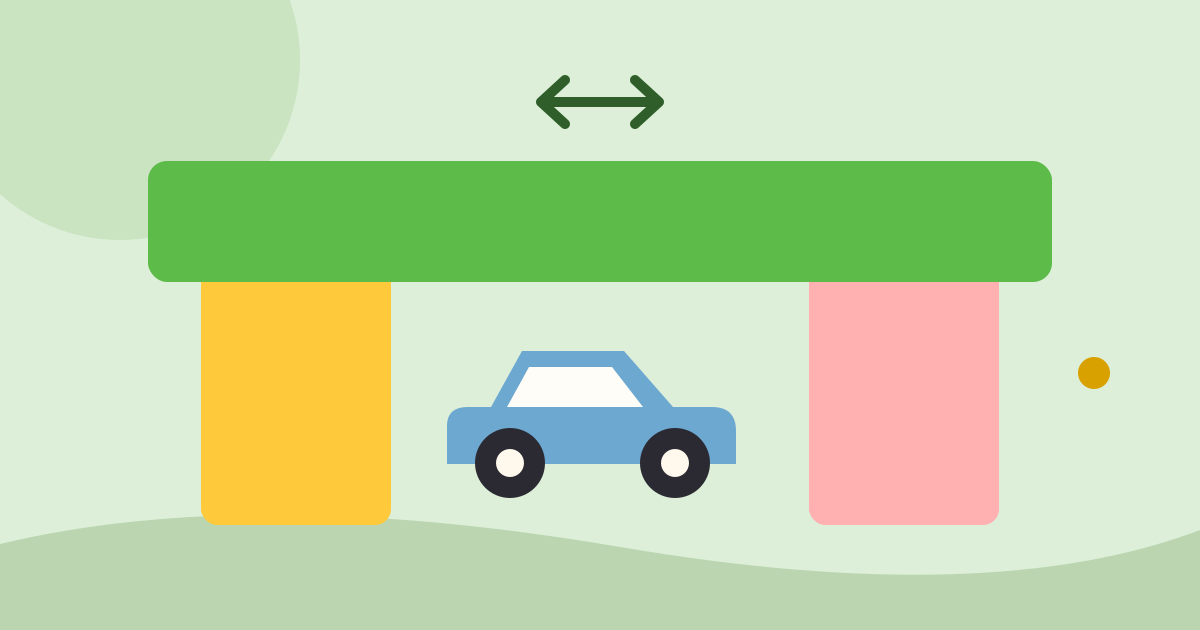
When building: describe one useful contrast. “This block is longer than that one. Which could reach across the gap?” Let your child try a block before you suggest another. A bridge falling down can simply become the next part of the game.
When doing a puzzle: pick a visible feature. “That piece has a straight edge. Here's a straight part of the frame.” You can turn the piece together. It is fine to name what you're trying: “I'll turn it a little. That side looks closer.”
When tidying: make a location specific enough to follow. “The animals go inside this box. The large dinosaur can sit beside it.” If the direction isn't clear, show the place. Tidying does not have to become a test of listening.
Let your child give the directions
Put a toy somewhere visible and ask where you should put a second one. “There” might be your first instruction. You can point and check: “Beside the bear?” After your child confirms, move the toy. You have supplied a useful word inside an actual conversation.
If they say “under the chair,” follow their plan. If they decide the toy should fly to the moon instead, the game has taken a turn. You can join in without bringing it back to the vocabulary you had in mind.
Keep the sentence useful for this child
A longer sentence is not automatically a better instruction. Begin with one relationship you can show. “Under the bridge” may be plenty. For a child who wants more, compare two arrangements or ask them to describe a route through a toy town. Pointing and moving the pieces are welcome parts of the exchange.
There is no reason to buy a special spatial-learning kit. Blocks, a familiar puzzle, paper shapes or the toys already being put away offer places to start. If shapes catch your child's interest, try turning a triangle around.